introduction

🐾 background
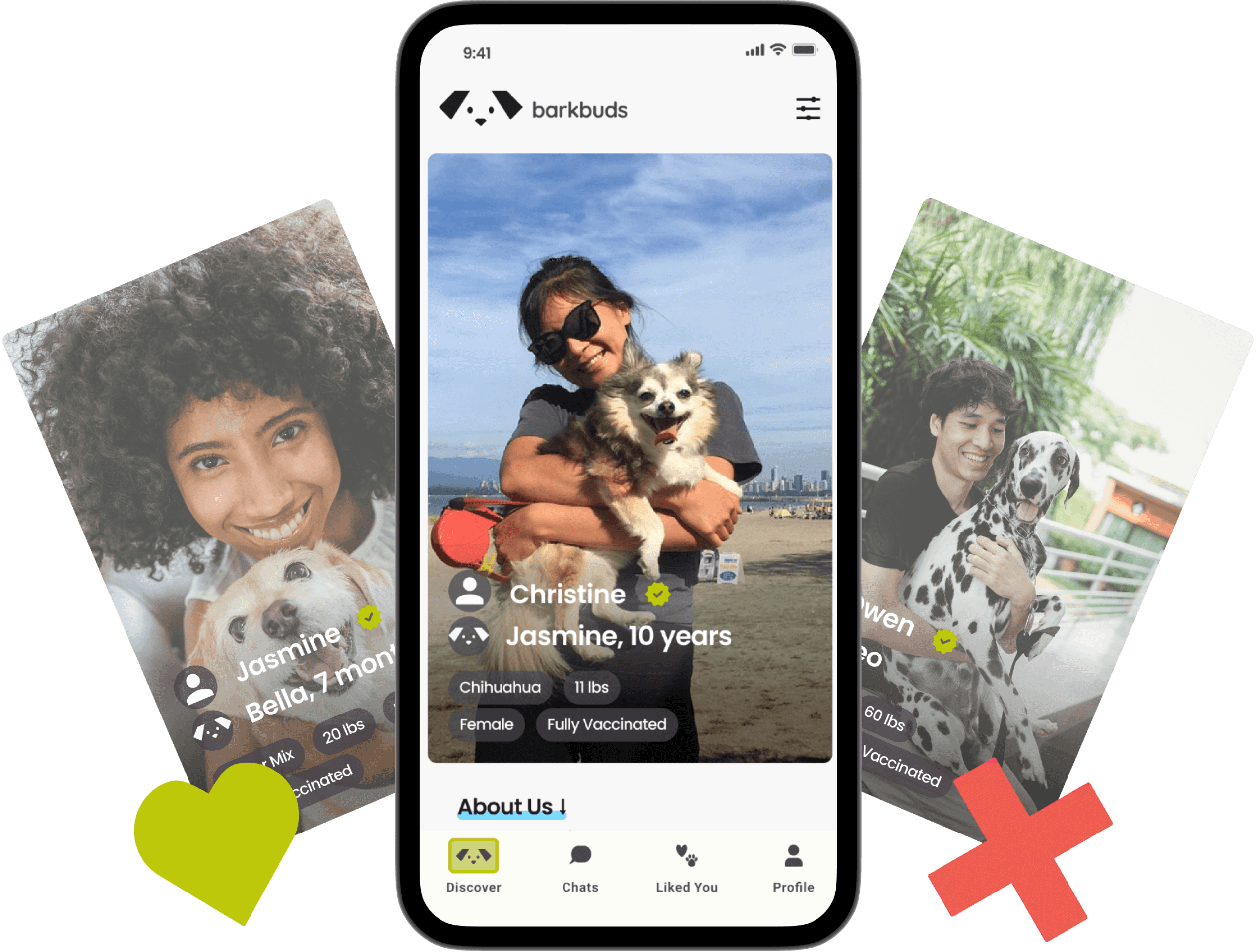
BarkBuds aims to facilitate connections between dog owners and dogs within a chosen city - imagine Hinge or Tinder for dogs! In an era where platforms for human connection flourish, there is an untapped niche for facilitating canine companionship. BarkBuds provides a platform specifically tailored to the needs of dogs and their owners, making it easier to foster friendships and socialize fur babies.
🐾 problem
Dog owners often face challenges in socializing their dogs and may end up doing so less than they would like. A common method for socialization is visiting dog parks, but 100% of the participants interviewed expressed hesitations due to the unpredictable behavior of other dogs, which can make it difficult to ensure positive interactions.


🐾 target audience
🎯 goals
research

Assumptions
Users want to connect with others who share their passion for dogs.
Dog owners want to form a community within their local geographical area.
When meeting in person, users are concerned about the safety and privacy of both themselves and their dogs.
Meeting people online is widely accepted.
First steps
The first steps in defining goals this project were:
Each of these steps helped me better understand the habits, pain points, and needs of dog owners.
interviews

🐶 Overview
🐶 5 Participants
Participants fell under one or more of the following categories:
Current dog owner (3/5)
Previous dog owner (4/5)
Prospective dog owner (2/5 had plans to get a dog soon but also had extensive experience with dog ownership)
Questions to ask:
🎾 Anecdotes
Is your dog social? Why or why not?
How did your dog make friends?
Based on your experiences, what advice do you have to give to new dog owners?
🎾 Interests
Why would dog owners want to connect?
Would people be interested in finding friends for their puppies?
Would you be interested in connecting with dog owners in your area?
🐶 Summary
As dogs are so truly cherished by their owners, I received very honest and thoughtful responses to my questions. The information gathered allowed me to meet my interview goals and five common themes emerged:

Importance of early socialization (5/5)
Early socialization helps puppies develop into well-adjusted, confident dogs by exposing them to various environments, people, and animals during their critical developmental period.
Health and safety concerns when meeting other dogs (5/5)
Ensuring dogs are healthy and monitoring their behavior during interactions can prevent the spread of diseases and avoid unwanted conflicts.
Value of training (5/5)
Training provides essential communication between dogs and owners, promotes good behavior, and ensures the safety of both the dog and others.
Need for responsible and dedicated dog owners (5/5)
Responsible dog owners are crucial for providing proper care, training, and socialization, ensuring their dogs lead healthy and happy lives.
Pros and cons of dog parks (5/5)
Dog parks offer socialization and exercise opportunities but are usually not appropriate for dogs who have not been trained to socialize or who have anxiety.
🐶 Painpoints
When it comes to training and owning a dog, participants shared similar painpoints about socializing their dogs. Moving forward with this project, I aimed to focus my attention to improving the chances of finding compatible and available playmates.
"The unpredictability of different dogs each day at doggy daycare makes me hesitant about bringing my dog."

"Young dogs can sometimes annoy older dogs, which may cause my older dog to snap."


"My dog is too anxious to play in groups of dogs and we do not know anyone close by with a dog to play with."
🐶 There was 100% interest in an app to connect dog owners.

App Purpose
1/5 participants expressed interest in an app to connect people through their mutual love of dogs and related activities.
4/5 participants showed enthusiasm for an app that helps dog owners arrange playdates for their dogs.

Demographic interest
3/5 new and prospective dog owners expressed a greater interest in using the app themselves.
2/5 owners with older dogs indicated that they already have established routines with their pets and may not find the app as useful for themselves. However, they noted that the app would be beneficial for new dog owners or those with puppies looking to build a routine and social connections for their dogs.
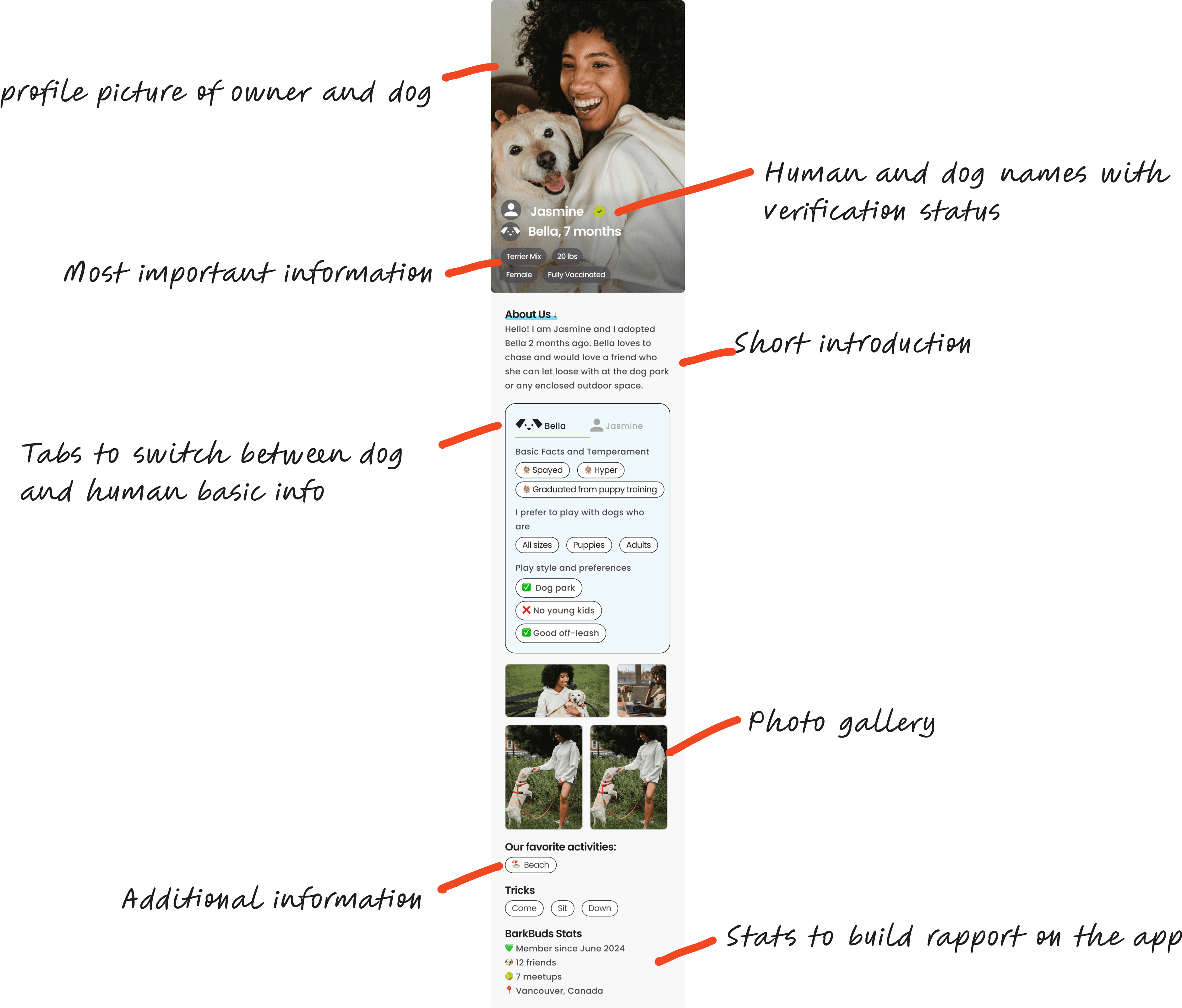
🐶 To build trust and assess compatibility, participants suggested details to include in a profile:
✅ Profile picture with owner AND dog
✅ Owner and dog's names, location, number of meetups through the app
✅ Dog's temperament, age, breed, weight, and vaccination status
✅ Photos and videos
✅ List of tricks/commands
✅ Schedule
✅ Likes and dislikes (activities, play style, compatibility)

user personas


By focusing heavily on safety and user compatibility, these personas guided my design decisions, ensuring that the implemented features addressed real user needs.
storyboard

🐾 Scenario
Bella the puppy is too shy to approach dogs at the park and has no friends. Jasmine wants to socialize her puppy by finding friends.
🐾 Persona
Jasmine the owner and Bella the 5-month-old puppy
competitive analysis
In comparing Bumble BFF, Rover, and Wag Buddy, I aimed to understand the notable features in each app that enhance user connectivity, safety, and engagement.

👍🏽 Strengths
In addition to general aesthetic, 5 features stood out of paramount:
Chat
User Verification
Location-Based
Profile
Photo Gallery
These features enhance users’ trust in each other and help keep personal information safe. Both Bumble BFF and Rover have modern interfaces to make it cool, appealing, and user-friendly.
👎🏽 Weaknesses
Wag Buddy is very dog-centric but users need more information about dog owners for trust and safety. It also looks outdated.
On Rover, users are not able to save profiles unless they contact them immediately.
Bumble's swiping feature might not be ideal for a dog-friend app, as unintentionally skipped users may not be easily found again.
prioritization
🐾 Next steps
After gathering and sorting through the information from research, my next steps were to create a roadmap and then user and task flows. Doing so allowed me to stay organized during the design process.
roadmapping
With numerous ideas gathered from the interviews, my first step in the design process was to prioritize which concepts to develop first.
Shown here are the MVP's for the first release of BarkBuds.

flows
After deciding on the essential features, it was time to create flows. By putting myself in the shoes of a potential user, I incorporated these features into five task flows and a user flow.
The task flow shown below demonstrates how users can find and connect with each other.


design
Based on research, 3 primary questions directed me in moving forward with the wireframes:
How can BarkBuds feel safe for users?
How could users learn more about each other before meeting?
How can the BarkBuds community be encouraged to meet in real life?
I divided the design process into 3 parts:
branding
Keywords and Moodboard
Since many dogs love to play with tennis balls, I looked to these images featuring tennis balls as the inspiration for the color palette. The bottom two pictures (Stanley Park in Vancouver and Dolores Park in San Francisco) are where dogs love to play and go on walks.

Colors

I chose tennis ball green as my primary color. Green is also a color often associated with nature and many dogs also love to play outside! The brightness of it conveys fun.

Blue is often associated with peace, loyalty, healing, and support. While this app is playful, the main goal of BarkBuds is to help dogs of all personalities, from shy to confident, find friends in the community. In using the bright blue, the interface will have playful accents.

Neutrals will be used primarily in this app for a contemporary feel, similar to Bumble and Hinge.
Logo

I settled on this geometric and simple design of a dog for BarkBuds's logo. It is versatile, scalable, and adaptable in different colors. The sharp angles, rather than rounded corners gives it a clean and cool feel. I also like that it is cute and distinguishable.
ui kit
components for the questionnaire

Since the onboarding questionnaire was extensive, creating components was essential for building the different parts of the form.
My goal was to make sure users could tell what they had selected, what buttons were active and inactive, and where they were in the onboarding progress. It was also important for me to give users the option to skip parts of the form, if desired.
creating icons for the nav bar

After deciding on the sections I needed for the app, I created icons and their states for the navigation bar.
The "Discover" Page is represented by the BarkBuds logo and appears first on the navigation bar as it is the landing page of the app.
I chose to use a heart and a paw to indicate the "Liked You" page, which is where users will be able to see who liked them.
The "Chat" and "Profile" icons are standard.
How can BarkBuds feel safe for users?


How could users learn more about each other before meeting?
Users can learn more about each other before meeting in real life in three ways:
Filling out a questionnaire and uploading photos to share information.
Viewing each other's profiles.
Messaging and calling each other directly for a more personalized interaction.
onboarding questionnaire
🐾 Users are encouraged to share their basic information to find compatible matches.

Once users have created an account, they have the opportunity to complete a questionnaire for their basic information. With this information, BarkBuds will be able to find them potential matches based on preferences such as age, size, temperament, and activities. Additionally, this information will be shown on their profiles for potential matches to see.
discover new profiles
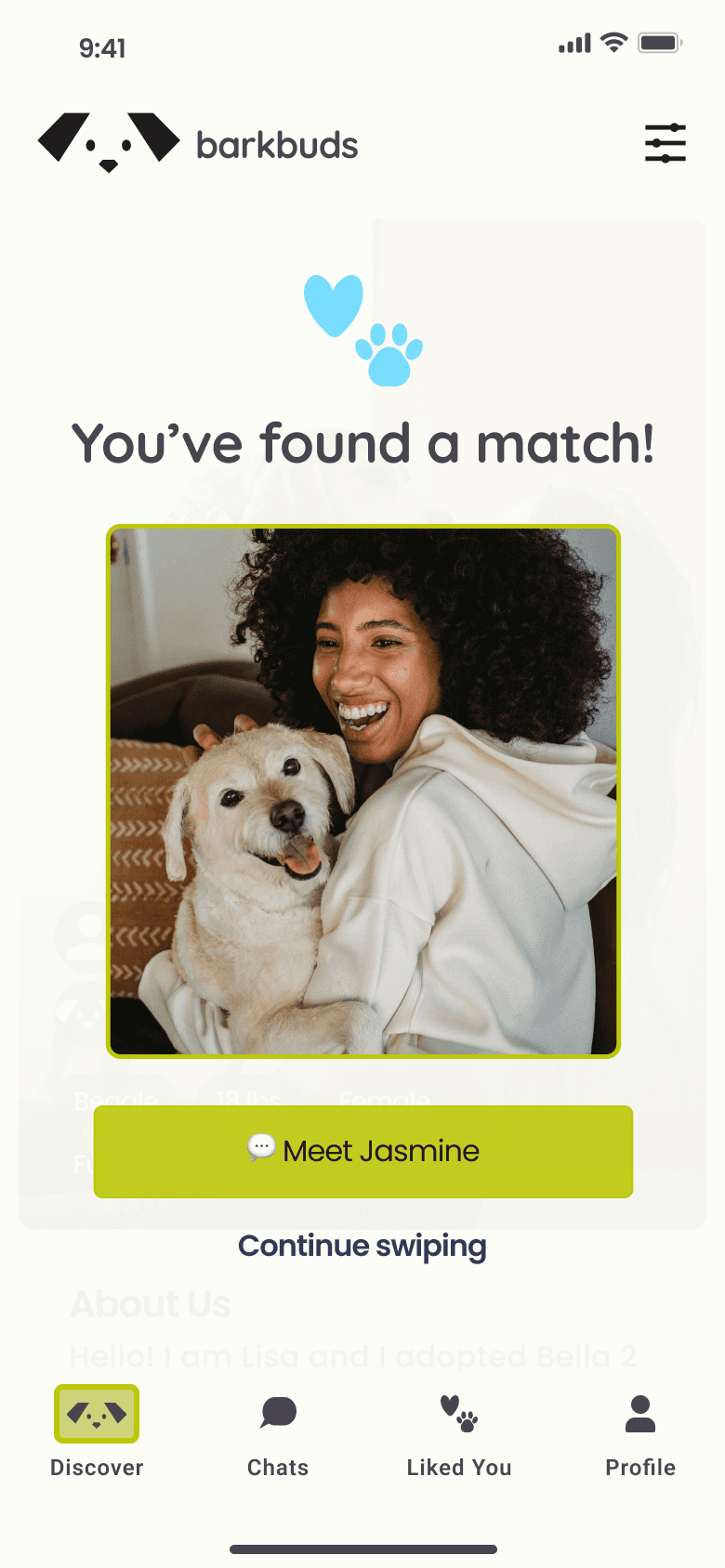
🐾 Swipe + Scroll = Efficiency


Despite drawbacks to swiping, as discussed in the competitive analysis, I decided to adopt the swiping feature commonly found in dating apps to discover new dog friends! The concept of swiping saves time in the messaging process by limiting communication to people who mutually share interest in each other.
Swiping also allows BarkBuds to learn user preferences and increase the likelihood of finding a match.
🐾 For easy access to information, users simply scroll to find out more.


testing and iterations
🐶 5 users
Recruited through email and Discord
4 current and previous dog owners
1 user with experience dog sitting and has had other pets
🐶 5 tests
5 tests over zoom
Moderated

🐶 4 Flows
Onboarding + Questionnaire
Photos and verification
Discovery (swiping)
Reaching out to a new match (Chat)
summary
Users enjoyed their testing experience, mentioning that it was smooth, intuitive, clean, and cohesive. Along with their support, they also provided helpful feedback to further improve the user experience and general aesthetic.
“This feels real. I would sign up my dog.”
"If I had a dog, I would be interested."
"I love this idea! I wish it were real."
test process
With as little guidance as possible, I had users talk me through each flow.
Testing the first flow:
Creating an account + onboarding questionnaire


During user testing, I was initially concerned about the length of the questionnaire. However, users found it to be appropriate and appreciated the level of detail, mentioning that it would help them find compatible friends.


I received a suggestion to reorder the content, which I found to be logical. Based on this feedback, I made the following changes:

failure to scroll
Was scrolling intuitive?
Knowing to scroll in the "Discover" flow proved to be an obvious issue in 80% of tests.
My goal was to make the profile pictures in the this flow as big as possible, filling the entire screen.
However, this was misleading as the page looked complete and users did not realize that they could scroll down for more info.

priority revision

final prototype
After completing the revisions, I finalized the prototype. I spent the most time on animating the swiping feature on Figma, which is seen in the raw form below. This was a learning curve for me and it was very satisfying once I finally figured it out!
To try the prototype from onboarding to finish, please click the button below.

conclusion
🐾 Biggest Lesson Learned
🌱 Growing as a designer

As a dog lover and dog owner of almost 17 years, creating BarkBuds was a project very close to my heart. I especially enjoyed connecting with dog lovers in both the research and testing stages.


