
introduction
background
It is estimated that 1.5 billion people worldwide are actively learning a new language. Whether this may be for fun, to prepare to move to a new country, to open up job opportunities, the ups and downs of the learning process is relatable to many.


problem
Learning a new language is a challenge for many people, especially when they live in a community where the language is not spoken. It can be difficult to find opportunities to practice for free and in-class settings do not prepare individuals for real-world contexts.
target audience
People who find it difficult to incorporate language-learning into their daily lives
People looking organize their language learning in a fun way
People who want to supplement their current learning journey
People who want to know how to participate in real-life situations and respond to native speakers
🎯 goals


research methods
Gain firsthand insight as to what worked and did not work in someone's language learning journey to fluency.
See what is worth keeping in language earning services, how apps keep users motivated, and what turns people away from using them.
interviews
Summary


What to find out
What ideas do people have to incorporate language learning into their daily life?
What activities could they combine language learning with?
What learning methods worked for people who reached fluency in adulthood?
I interviewed 5 participants who spoke more than one language fluently.
4/5 participants learned and reached fluency in a new language in adulthood
5/5 users learned a new language in adulthood
5/5 users learned a new language because they were moving to a new country
5/5 users emphasized the important of learning through conversation with native speakers in real-life contexts
The data gathered from these demographics helped me focus on a specific audience—adults who are moving to a new country and need to communicate with native speakers.


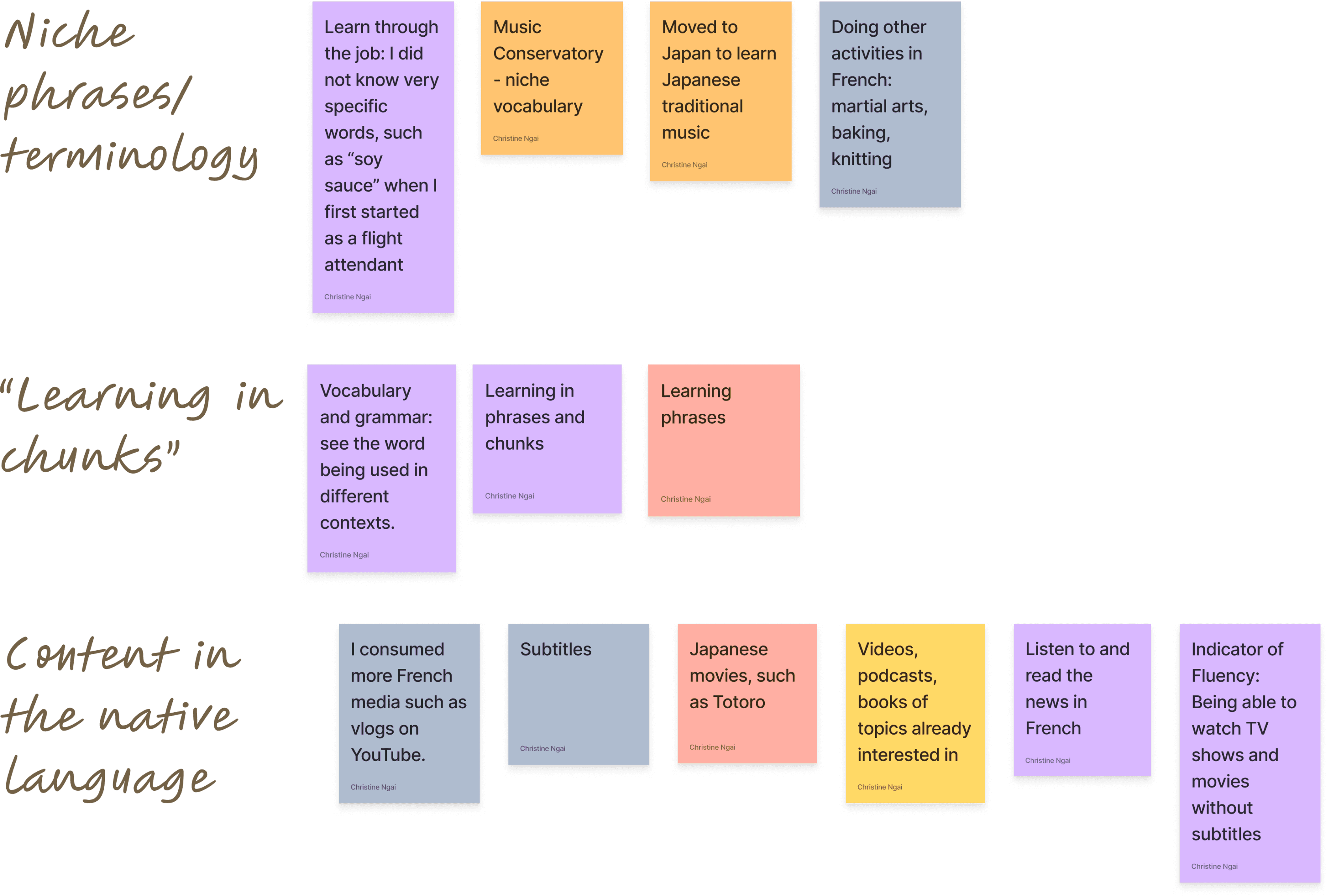
Motivations for learning a language.
Having the right kind of motivation is imperative for learning a language, regardless of method. Participants who reached fluency in adulthood shared what kept them going through a challenging process.
Daily Practice. Consistency is key!
Concrete deadlines such as an exam or moving date.
Practicing with native speakers
Constructive and kind feedback
Painpoints
Learning a new language is a process that involves many ups and downs. Many of the painpoints involved not being able to practice the language in real-life situations.
Here are some quotes from the interview sharing the struggles of learning a new language:
"I had little to no progress due to few oppotunities to speak to natives."
"Studying through textbooks did not prepare me for real-life interactions."

"Native speakers kept switching to English when I was trying to practice German with them."
POV → HMW

POV
I would like to explore ways to help busy people find the time to integrate language learning into their daily lives so that they may reach fluency as early as possible
HMW
How might we help busy people moving to a new country reach their language learning goals in an ambitious timeline?
competitive analysis
I chose Duolingo, Drops, and Tandem for the competitive analysis (May 2023). These three platforms are popular for language learning and were mentioned in user interviews.
Being corrected and having free access are important. While communication with native speakers is the most effective method for language learning, according to interviews, only Tandem offers that.

These three apps come with free access and are effective in correcting mistakes.
prioritization
Next Steps
After gathering and sorting through the information from research, my next steps were to create a feature set and user and task flows. Doing so allowed me to stay organized during the design process.
feature set
With ideas gathered from interviews and competitive analysis, my first step in the design process was to prioritize which concepts to develop for a basic viable product.
These are the MVP's for the first release for Parlezy.

flows
Completing user flows helped me see how the different tasks intersected.


design
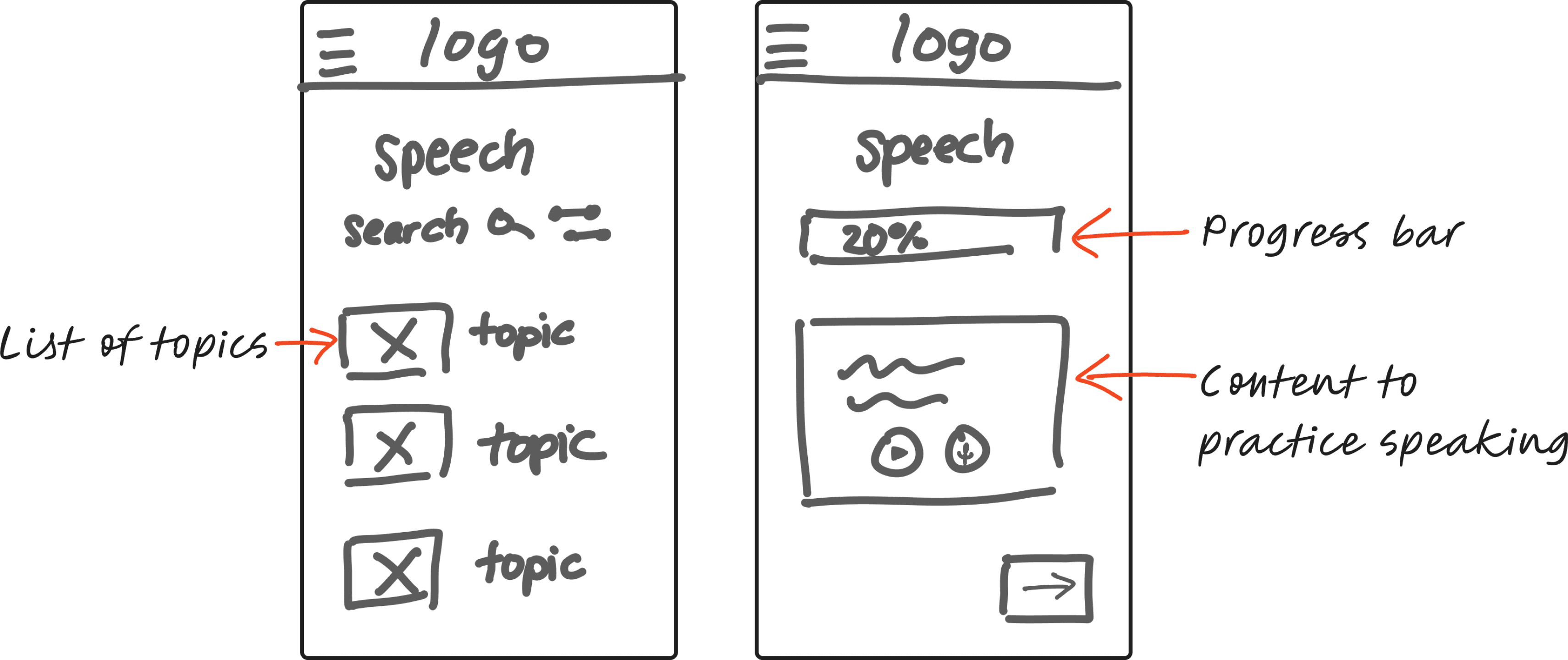
Through the design, I wanted to maximize the opportunities users have to practice speaking.
I created the following three flows to help me achieve this goal.
Onboarding
Speech Practice
Study List
How do I maximize the opportunities users have to practice speaking?

language exchange
Once users complete onboarding, they are encouraged to find friends around the world.
Friends are necessary to collaborate with on Study List as well as to engage in language exchange through DM-ing and calling.




branding
Colors

My goal with branding was to evoke cheerfulness and optimism in order to promote a sense of community and sharing. I want users to overcome intimidation that comes with practicing a new language.
I hope that with brighter colours, users can be drawn to use the product with more enthusiasm.
Color choices have gone thorugh accessibility checks and pass with an AA or AAA rating.
Logo
For the Parlezy logo, I wanted to emphasize of speech, exchange, and friendliness.
Seen below, I experimented with lower and upper case letters, serif fonts and sans serif fonts, and different graphics.

These are the logos that did not work.

The Finalized Logo
After discussing with fellow designers, they voted for a logo with the p-shaped speech bubble and the font 'Syne.' The lowercase letters create a less formal and hopefully less intimidating atmosphere.
Removing the graphics representing exchange also opens up possibilities for the app's future features.


testing and iterations
5 users
Recruited through email and Discord
5 individuals who have learned second languages
5 tests
5 tests over zoom
Moderated

3 Flows
Onboarding + Questionnaire
Speech Practice
Study List
summary
For the most part, users complimented the design of Parlezy for being clean, easy to follow, and fun. Though users did not struggle to complete the flows, they had suggestions for improvement which were helpful for further enhancing clarity.
"I like being able to collaborate and add friends."
"Warm, friendly, welcoming."
"This is an effective way to get real-life practice."
tasks
The onboarding flows matched the expectations of users and they succeeded in completing the flow. Once they had created an account, I gave them pretend tasks such as:
Sign up for this service and create a profile
Do you feel that necessary and appropriate questions were asked?
You are too nervous to speak to a native speaker. Where will you navigate to?
What do you gather from this landing page?
How long should this exercise be?
You come across a new word and you want save it to study. What do you do?
Rate the difficulty of task. How intuitive was it?
Assumption:
Because of the descriptive names of the different parts of the app, I did not think users would struggle too much in figuring out where to go.
Result:
Participants followed similar paths to achieve the same goal. Users were able to identify the purpose of each section of the app.
After testing, they provided suggestions on improving the UI for enhancing clarity and to keep content as relevant as possible.
Post-test revisions: Enhancing the wording
Parts of the first iteration did not hinder the flow, but still had room for improvement.
One example is the editing the basic information on the study list icon.

Post-test revisions: Cleaning up UI
With clearer UI, there is more guidance working through a flow that is not typically practiced in day-to-day life. Here is the final version of the Speech Practice flow. Revisions are annotated in the pink rectangles.

final prototype
After completing the revisions, I finalized the prototype. The flows were clearer to follow once I made the changes suggested by users in testing.
To try the prototype from onboarding to finish, please click the button below.

conclusion
🎧 Listening to the audience
Interview participants were looking for opportunities for connection with people who spoke the language they were learning.
Prior to interviews, I had in mind an app that would combine learning two skills in one, such as cooking and language-learning. While a couple of users suggested something similar, all users emphasized the point that speaking was paramount to achieving fluency.
After the interviews, I set my ideas aside and re-oriented my project to creating a platform that maximized conversation skills.
🌱 What's next?
As I learned in the research stage of this project, there are so many ways to learn a new language! Motivation is key and finding ways to reinforce new material is essential for the growth of Parlezy. In future updates, these are some features to be considered:
Reward system
Aural and haptic feedback
Time limits
Spell-check
Translator
Music player


